
Why Choosing the Right Multi Color Removal Laser Technology Matters
Not all tattoo removal is created equal — and if your ink includes more than just black, the technology used makes a huge difference.
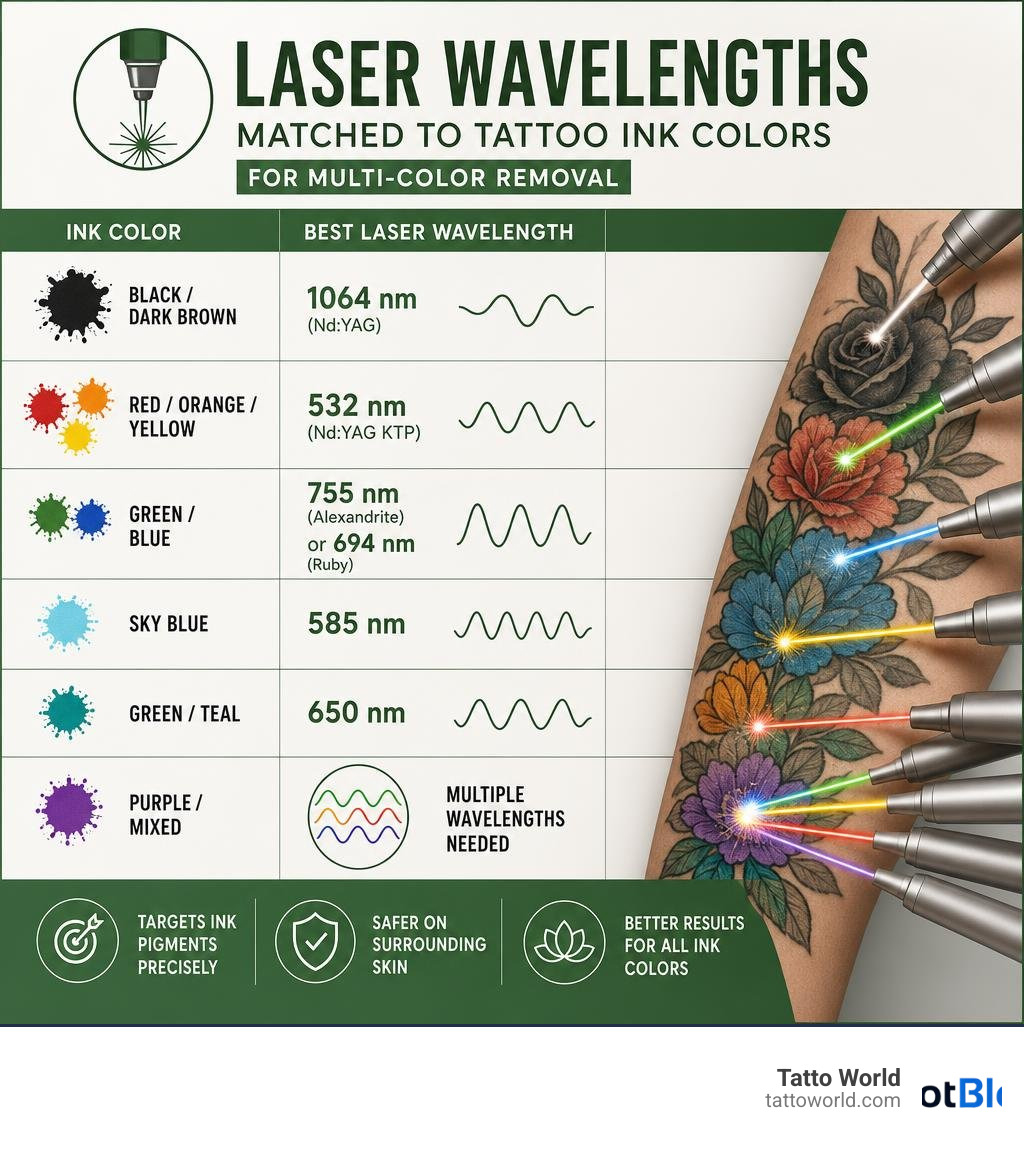
Here’s a quick breakdown of the best laser wavelengths for each tattoo color:
| Ink Color | Best Laser Wavelength |
|---|---|
| Black / Dark Brown | 1064 nm (Nd:YAG) |
| Red / Orange / Yellow | 532 nm (Nd:YAG KTP) |
| Green / Blue | 755 nm (Alexandrite) or 694 nm (Ruby) |
| Sky Blue | 585 nm |
| Green / Teal | 650 nm |
| Purple / Mixed | Multiple wavelengths needed |
The short answer: No single wavelength removes all colors. Effective multi-color tattoo removal requires a laser system with at least three wavelengths — and picosecond systems generally outperform older nanosecond technology for both results and safety.
Tattoo regret is more common than you might think. In 2021, about 26% of Americans had at least one tattoo — and the global tattoo removal market is on track to hit $392 million by 2027, growing at nearly 8% per year. A big part of that demand comes from people with colorful, multi-ink designs that are notoriously harder to remove than simple black tattoos.
Black ink absorbs a wide range of laser wavelengths. Colored inks? They’re far more selective — each pigment only responds to a narrow band of light. That means treating a tattoo with reds, greens, yellows, and blues requires multiple laser wavelengths, more sessions, and a provider who knows exactly which tool to use on which color.
That’s exactly what this guide is here for.
I’m Faisal S. Chughtai, and through Tattoo World I’ve spent years researching and writing about every stage of the tattoo journey — including the science behind multi color removal laser technology and what actually works for complex, colorful designs. In the sections below, we’ll compare the leading systems head-to-head so you can walk into any consultation fully informed.
Why Multi-Color Tattoos Pose a Unique Challenge
When we look at a multi-color tattoo, we see a beautiful piece of art. When a dermatologist or laser technician looks at it, they see a complex chemical puzzle.
Single-color tattoos, especially those rendered entirely in black carbon ink, are the easiest to remove. Black ink is a universal absorber; it sucks up almost every wavelength of light you throw at it. Multi-color tattoos, on the other hand, are highly selective. If you try to treat a bright green pigment with a laser wavelength designed for red ink, the light will simply bounce off, leaving the skin irritated but the ink completely untouched.
Understanding these complexities can save you time, skin damage, and money. If you are planning your removal journey on a budget, you might also want to explore Affordable Tattoo Removal Options For Every Budget to see how to balance costs with advanced technology.
The Physics of Ink Absorption and Reflection
The science of laser tattoo removal relies on things called chromophores — molecules that absorb specific wavelengths of light. In a tattoo, the ink particles act as artificial chromophores.
When a laser hits the skin, it must match the absorption spectrum of the target pigment. If the ink color reflects the laser light instead of absorbing it, no energy is transferred, and the ink particles will not break. For example:
- Red ink reflects red light (which is why it looks red to our eyes) and absorbs green light.
- Green ink reflects green light and absorbs red or near-infrared light.
- Yellow ink has a very narrow absorption band, making it incredibly stubborn because it reflects almost all visible light wavelengths.
Furthermore, tattoo pigments are often deposited at varying depths within the dermis. Heavier, denser pigments require deeper laser penetration, which is heavily influenced by both the wavelength and the spot size of the laser beam.
Hardest vs. Easiest Ink Colors to Remove
To give you a realistic expectation of your removal journey, let’s categorize colors by their general resistance to laser treatment:
- Easiest (High Absorption): Black and dark brown. They absorb almost all laser energy, making them highly responsive to the standard 1064 nm wavelength.
- Moderate (Color-Specific Wavelengths Needed): Red, dark orange, and dark blue. These respond exceptionally well to 532 nm and 755 nm wavelengths, respectively.
- Hardest (Highly Resistant): Green, yellow, sky blue, and orange. Green requires specialized Ruby (694 nm) or Alexandrite (755 nm) lasers. Yellow is notoriously difficult because its absorption spectrum is so close to skin melanin.
- The Wild Card (White Ink): White ink often contains titanium dioxide. When struck by laser light, this compound can undergo a chemical reduction reaction, instantly turning the ink dark gray or black.
Treatment Timelines and the Body’s Elimination Process
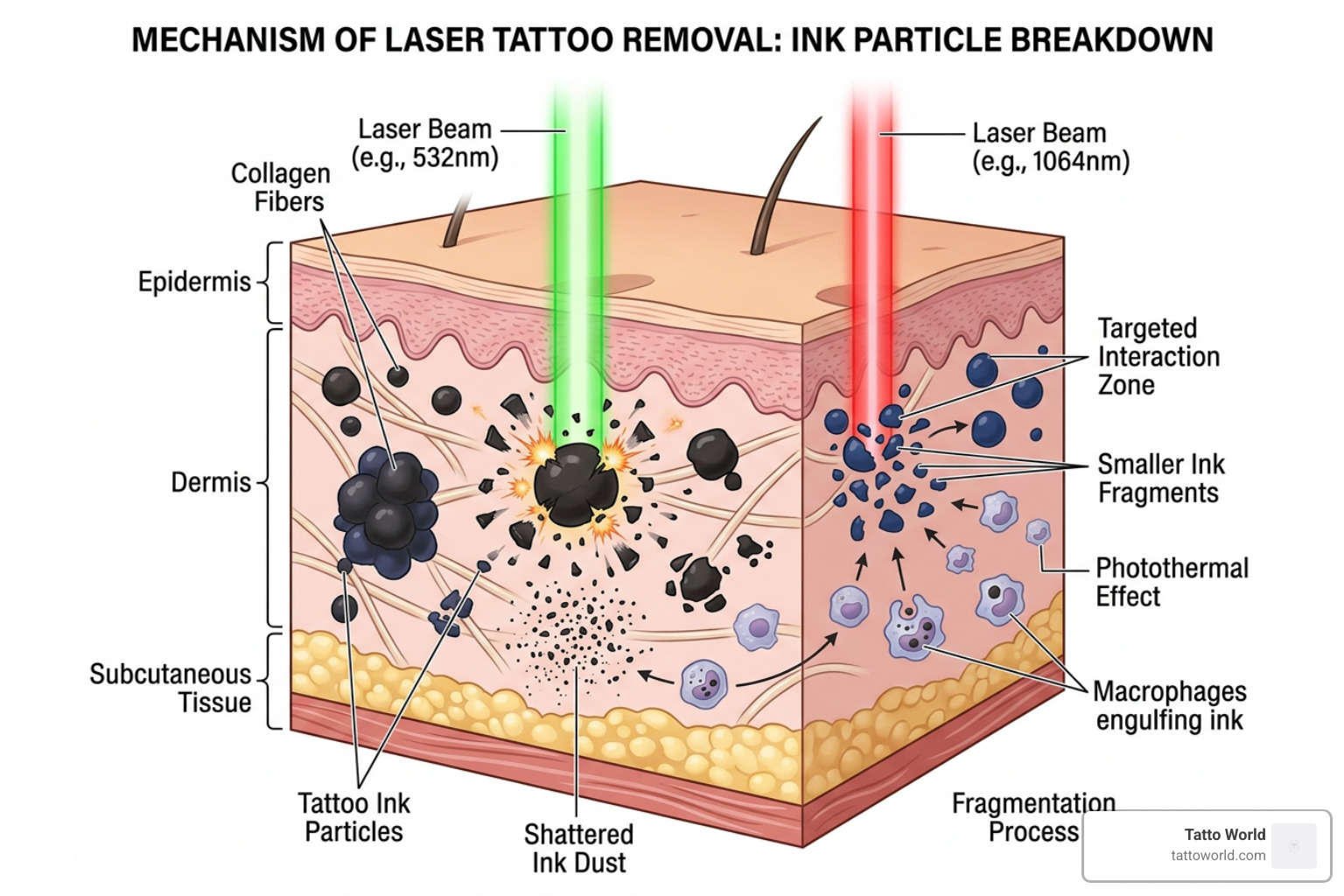
Once a multi color removal laser shatters the tattoo ink, the laser’s job is actually over. The real work of clearing the pigment is done by your body’s immune system.
The intense energy from the laser breaks the large ink particles into microscopic fragments. Your body recognizes these fragments as foreign invaders, triggering an immune response. Specialized white blood cells called macrophages engulf the shattered ink particles and transport them through the lymphatic system to the liver, where they are filtered out and permanently eliminated.
Because this biological clearance takes time, treatments cannot be rushed. Sessions are typically spaced 6 to 8 weeks apart (and sometimes up to 12 weeks for multi-color designs) to give your lymphatic system ample time to clear the debris. To ensure your skin is in the hands of professionals who respect this biological timeline, check out our curated list of No More Regrets With These Top Rated Tattoo Removal Clinics.
The Science of the Multi Color Removal Laser
To effectively clear a rainbow of ink, modern laser systems rely on a principle called selective photothermolysis. This means delivering a specific wavelength of light in an incredibly short burst so that it selectively heats and destroys the target pigment without damaging the surrounding skin tissue.
In recent years, researchers have also focused heavily on the photoacoustic effect. Instead of relying purely on heat (photothermal effect), ultra-short laser pulses create a rapid shockwave that mechanically shatters the ink. This mechanical shattering is highly effective and significantly reduces the risk of thermal burns. You can read more about these clinical findings in this Effects of picosecond laser on the multi-colored tattoo removal using Hartley guinea pig: A preliminary study | PLOS One .
Wavelength Selection for Full-Spectrum Target Colors
To clear a multi-colored tattoo, a clinic must use a device that can output multiple wavelengths. Here is how the primary wavelengths target specific colors:
- 1064 nm (Nd:YAG): The gold standard for dark inks (black, dark blue, brown). It penetrates deeply into the dermis and is highly safe for darker skin types because it bypasses melanin.
- 532 nm (Nd:YAG KTP): Highly absorbed by red, orange, and yellow pigments. Because it is highly absorbed by melanin as well, it must be used with caution on darker skin tones.
- 694 nm (Ruby): Ideal for stubborn green, teal, and blue pigments, as well as resistant black inks.
- 755 nm (Alexandrite): Excellent for green and blue inks, providing a great balance of pigment absorption and deep tissue penetration.
Picosecond vs. Nanosecond Pulse Durations
The duration of the laser pulse (how long the beam actually touches the skin) is measured in either nanoseconds (one-billionth of a second) or picoseconds (one-trillionth of a second).
- Nanosecond Lasers (Q-Switched): These systems deliver energy in rapid bursts that heat the ink particles until they expand and crack. While highly effective, the photothermal (heat) energy can spill over into surrounding tissue, causing discomfort and requiring longer healing times.
- Picosecond Lasers: These deliver energy up to 100 times faster than nanosecond lasers. This ultra-fast pulse creates a primarily photoacoustic reaction. The ink is literally pulverized into dust-like particles rather than pebbles, making it much easier for macrophages to clear. Picosecond lasers generally produce less tissue injury, fewer epidermal changes, and faster overall healing.
Spot Size, Pulse Modulation, and Depth Control
Laser settings must be precisely adjusted throughout your treatment journey.
- Spot Size: A larger spot size (e.g., 8 mm to 10 mm) allows the laser light to penetrate deeper into the skin, which is crucial for targeting deep-seated ink during early sessions. Smaller spot sizes are used later for superficial, stubborn spots.
- Pulse Modulation (Single vs. PTP/Double Pulse): Some advanced systems use Photoacoustic Therapy Pulse (PTP) or double-pulse modes. This splits the laser energy into two consecutive pulses separated by a tiny fraction of a millisecond. This reduces peak heat on the skin while still delivering high total energy to shatter the ink.
For clinics looking for a professional-grade platform that utilizes these advanced pulse modes, the EO Q-switched Nd YAG laser GCP155 – COOLPRETTY is a prime example of an EO (Electro-Optic) Q-switched system designed to balance high output energy with skin safety.
Comparing Leading Laser Technologies
To help you understand the landscape of professional removal devices, let’s break down the leading technologies on the market as of June 2026.
Comparing Leading Multi Color Removal Laser Technologies
When evaluating Q-switched (nanosecond) systems, beam homogeneity is everything. Older lasers often suffered from “hotspots” — uneven distribution of energy across the laser spot that could cause pinpoint bleeding, scarring, or uneven fading. Modern systems solve this by utilizing flat-top beam profiles, ensuring energy is distributed perfectly evenly across the target area.
- Fotona QX MAX: This is widely recognized as one of the highest-performance single-pulse Q-switched systems. It features a unique single-pulse technology that prevents “optical shielding” (where shattered pigment from a rapid second pulse blocks the laser from reaching deeper ink). It offers four wavelengths (1064 nm, 532 nm, 650 nm, and 585 nm) to target virtually any color. You can explore its full specifications on the QX MAX | Fotona product page.
- Asclepion NanoStar System: This German-engineered system is famous for its “mixed technology,” which allows providers to emit multiple wavelengths simultaneously or sequentially. It also features OptiBeam II technology, creating a highly precise square, flat-top beam profile to eliminate hotspots. Learn more about its configuration options on the NanoStar_EN – ASCLEPION page.
Advanced Picosecond Multi Color Removal Laser Systems
For the ultimate in speed, comfort, and efficacy, picosecond systems represent the absolute cutting edge of multi-color removal.
- Fotona StarWalker MaQX: This system is a hybrid powerhouse. It combines the high peak energy of nanosecond pulses with the ultra-short precision of picosecond pulse modalities. It utilizes Adaptive Structured Pulse (ASP) technology to shape the laser pulse to match the bio-photonic dynamics of different skin types and ink colors. Read more about this award-winning system at Fotona StarWalker® MaQX – Home | Fotona .
- Astanza Trinity Platform: The Trinity is a legendary three-wavelength system that pairs a Q-switched Nd:YAG laser with a high-powered Ruby laser. By combining 1064 nm, 532 nm, and 694 nm wavelengths in one platform, it provides true full-spectrum removal, making easy work of stubborn lime greens and sky blues. Check out how it works on the Laser Tattoo Removal Machine: Full Color Tattoo Removal page.
Frequently Asked Questions About Multi-Color Laser Tattoo Removal
Can lasers completely remove neon or pastel tattoo inks?
Yes, but they are highly challenging. Neon and pastel inks are often created by mixing standard pigments with titanium dioxide (white) or zinc oxide to make them look brighter. Because these inks reflect a vast majority of visible light, they require highly specialized wavelengths (like 585 nm for sky blues or 650 nm for teals) and often require more sessions than standard jewel-toned colors.
Why does white tattoo ink sometimes turn black after laser treatment?
White ink is heavily loaded with titanium dioxide. When exposed to the high-intensity light of a multi color removal laser, the titanium undergoes a rapid chemical reduction reaction (changing from $TiO2$ to $Ti2O_3$). This turns the pigment a dark grey or black almost instantly. Fortunately, a skilled technician can treat this newly darkened ink in subsequent sessions using a standard 1064 nm wavelength, but it does add steps and time to your removal timeline.
How painful is multi-color laser tattoo removal compared to getting the tattoo?
Most patients describe the sensation of laser removal as similar to a heavy rubber band snapping repeatedly against the skin, accompanied by a intense heating sensation. Because multi-color removal requires different wavelengths (some of which are absorbed more superficially in the skin), the sensation can vary from color to color. To get a realistic, unfiltered look at what to expect, check out our guide on The Rubber Band Reality Of Tattoo Removal Pain.
Conclusion
Removing a multi-color tattoo is a journey that requires patience, biology, and the right physics. Because different pigments respond to entirely different bands of light, choosing a clinic equipped with a true multi color removal laser system — one that offers multiple wavelengths and advanced pulse delivery — is the single most important decision you will make.
Whether you opt for a high-performance Q-switched system like the Fotona QX MAX or a state-of-the-art picosecond platform, understanding how your body clears the ink will help you set realistic expectations.
Ready to take the next step toward clean skin? Explore our comprehensive tattoo removal guides to find more expert tips, clinic recommendations, and post-session aftercare advice.